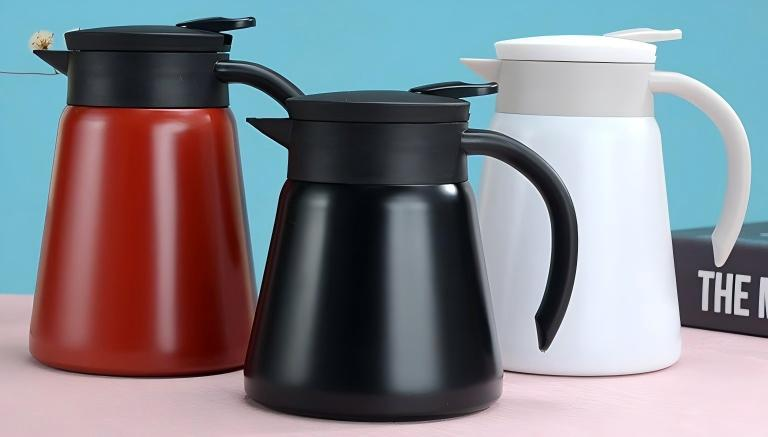
The inventor of the thermos flask was British chemist and physicist James Duvall in 1892, hence it is also known as the Duvall flask.
The concept of a thermos bottle is simple: the bottle has an inner wall and an outer wall; There is a vacuum between the two walls. Thermal conduction and convection cannot occur in vacuum, while the metal reflective layer coated on it can reflect thermal radiation. So any liquid poured into a bottle can maintain its original temperature for a considerable period of time. That’s why thermos bottles can keep drinks warm in winter and cool in summer. Many people who have traveled multiple times find it hard to imagine what it would be like without a thermos.
Duval produced liquid oxygen at a low temperature of -240 degrees Celsius In order to preserve this liquid oxygen, he designed a bottle that cannot transfer heat in or dissipate it The thermos we use evolved from this’ Dewar flask ‘ Duwa’s thermos is designed based on heat transfer: firstly, it is made of two layers of glass bottles, with a vacuum in the middle of the bottle to isolate the heat conduction and convection of air; Secondly, the bottle wall is coated with silver, just like a mirror reflecting light, which can reflect the radiation of heat back into the bottle; Thirdly, cap the bottle with a cork to prevent heat from escaping from the bottle. If used to hold boiling water, it becomes a thermos
However, it was German glassmaker Reinhold Berg who recognized that thermos bottles can be useful in various situations. He obtained the patent for the thermos bottle in 1903 and formulated a plan to put it into the market. Berg even held a competition to give his thermos a good name. The winning name he chose was’ Seymos’ (meaning hot water bottle), which is the Greek word for heat. Berg’s product was very successful, and soon he shipped thermos bottles to various parts of the world.Thermos flasks are often used for scientific purposes, such as when liquids need to be kept at a constant temperature. Vaccination vaccines, serum, and other liquids are often transported in thermos flasks. The thermos is no longer coated with mercury. Before the 1960s, it was coated with silver and magnesium oxide.